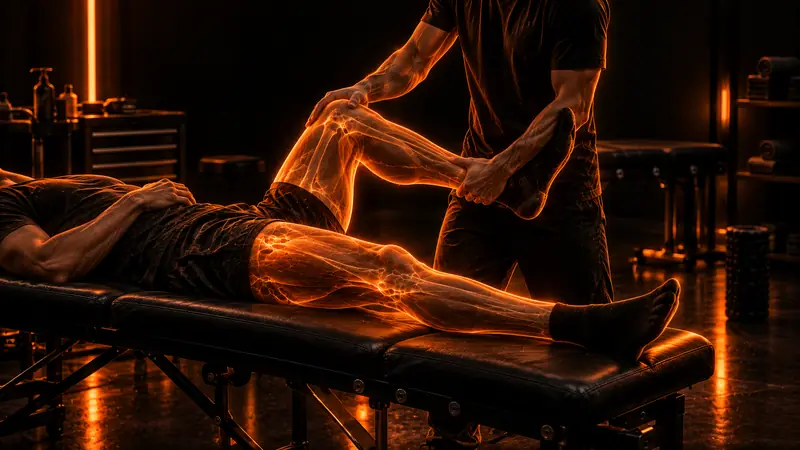
Picture a hotel corridor the night before a road game. No gym, no bands, ten minutes before bed. A player needs to wake up his hips, and a staff member kneels next to him and offers his own hands as the resistance.
That is manual resistance training, or MRT: the load comes from a partner instead of a plate. It is old, cheap and portable, and it is easy to oversell. This article sets out what the research actually shows, what it does not, and how we use it in practice.
What manual resistance training is
In MRT a partner provides the external resistance with their hands, a limb or their body, while the athlete moves, pushes or holds. A 2023 trial defines it simply: the external resistance is provided by a spotter (Dorgo et al., 2023).
It is not manual therapy. Nobody is mobilising a joint or treating a tissue. The partner is a variable resistance, and the useful part is that he can feel the athlete’s effort and change the load rep by rep. In our teaching we reduce it to three actions: the athlete pushes, pulls or holds, and the partner sets how hard the answer is.
Does it build strength like weights?
In healthy people, the trials we found say yes, within limits.
- In 84 college students randomised to 14 weeks of MRT or of an identically structured weight programme, both groups improved bench press and squat strength and muscular endurance, with no significant difference between them (Dorgo et al., 2009). The body-composition results of that trial, published later, showed lean mass rising and fat mass falling in both groups (Dorgo et al., 2023).
- In 222 adolescents in school physical education, classes complemented with MRT improved all six fitness tests and did better than regular classes in most of them at 9 and 18 weeks (Dorgo et al., 2009b).
- In an 8-week trial of 30 young adults, MRT raised leg press strength and weights raised bench press and leg press, with no change in body composition in either group (Terrazas et al., 2025).
- In 20 recreationally trained men (8 weeks, two sessions a week), neither group changed significantly, although the effect size for lat pulldown favoured MRT (g = 0.84). The authors concluded the two methods were similarly effective and that MRT can be a supplement or an alternative (Chulvi-Medrano et al., 2017).
The evidence says MRT can work. It does not say it works better than a barbell.
What the research does not tell you
Read those four studies again and the gaps are clear.
- The participants were students, adolescents and recreational lifters. We did not find a trial in basketball players or in a rehabilitation population among the studies we reviewed.
- The samples are small and short. Eight to fourteen weeks, from 20 to 84 adults, apart from the school study.
- The load is not measured. A spotter’s push cannot be written in kilograms. Two sessions with two different partners are not the same session.
- There is a ceiling. A strong, trained athlete can overpower the partner. That is why MRT does not replace the weight room for maximal strength when the weight room is available.
These are our reading of the studies, not claims from them. They are the reasons we position MRT as a complement, not as a replacement.
Where it earns its place in basketball
Lower limbs carry most of the injury burden in basketball. A systematic review of 12,960 injuries found 63.7% in the lower limb, with 21.9% at the ankle and 17.8% at the knee (Andreoli et al., 2018). Those are the joints where being able to control load by hand is most useful. Our working list of where MRT fits:
- Early and mid rehab, with clearance. You can choose the angle, the speed and the effort for one joint, and stop when the athlete asks. The physio keeps the lead.
- Activation before training or games. Hips, adductors and ankles in the corridor, with no equipment.
- Travel and low-equipment days. The hotel room is a gym if there are two people in it.
- Teaching control. The athlete has to hold a position while someone pushes. That is also a test of whether he can.
- Layered on other methods. Hands first to find the position, then a band or a weight to load it.
How we measure and dose it
The weak point of MRT is measurement, so we add some.
Hand-held dynamometry. A systematic review of 17 manuscripts found minimal differences between hand-held and isokinetic dynamometers, and concluded that hand-held devices are reliable and valid for muscle strength in the clinic (Stark et al., 2011). It gives the partner a number to repeat and compare, and it allows left against right.
Effort scales. The repetitions-in-reserve scale was built for the squat, where perceived exertion tracked bar velocity closely (Zourdos et al., 2016). To our knowledge it has not been validated for MRT. We use it as a common language between athlete and partner, not as a measurement.
Rules we repeat to every partner:
- Choose the lever. The farther from the pivot you push, the harder it is for the athlete. It is your intensity dial, so choose it on purpose.
- One hand fixes, the other works. The stabilising hand keeps the segment that must not move.
- Contact, do not grab. A flat hand where you want the force, so the athlete feels exactly where to push.
- Keep the command simple. Push, pull or hold.
- Use your body, not only your strength. For hips and knees, kneel, lean and brace; arms alone will make you the weak link.
- Compare sides. Differences between legs matter more than the absolute number.
- Before you add, check. Before loading a muscle, look at what the opposing muscle can do. This is our working habit, not something the studies above tested.
Can you combine it with other methods?
Yes, and that is where we find it most useful. Blood flow restriction is one example. A meta-analysis of 20 rehabilitation studies found that low-load training with blood flow restriction increased strength moderately (g = 0.52), but less than heavy-load training (g = 0.67), and that more research is needed on individual prescription (Hughes et al., 2017). A position stand covers method and safety (Patterson et al., 2019). That topic needs its own care and, in rehab, the clinician’s decision. The point here is only that a hand-applied load can be combined with other tools, not that the combination is proven.
The short version
- MRT means the resistance comes from a partner. It is not manual therapy.
- In healthy students, adolescents and recreational lifters it improved strength and fitness about as much as weights in the trials we found.
- We did not find trials in basketball players or in rehab populations. Treat it as a useful complement, not a proven replacement.
- Its weak point is that the load is not measured. Add hand-held dynamometry and a shared effort scale.
- It earns its place in rehab (with clearance), activation, travel and teaching control.
- After an injury, follow the progression set by the doctor or physiotherapist.
Learn it hands-on
Reading about MRT is the easy part. The technique lives in the details: where the fixing hand goes, how you give the command, how you ramp the effort. We are preparing a video course with the method, the exercise menu for lower limb, upper limb and core, and the measurement tools: Manual Resistance Training (MRT): Strength Without Equipment (coming soon). You can join the waitlist below to hear first.
References
- Dorgo S, King GA, Rice CA. The effects of manual resistance training on improving muscular strength and endurance. J Strength Cond Res. 2009;23(1):293-303. PubMed 19050653
- Dorgo S, King GA, Candelaria NG, et al. Effects of manual resistance training on fitness in adolescents. J Strength Cond Res. 2009;23(8):2287-2294. PubMed 19826296
- Chulvi-Medrano I, Rial T, Cortell-Tormo JM, et al. Manual resistance versus conventional resistance training: impact on strength and muscular endurance in recreationally trained men. J Sports Sci Med. 2017;16(3):343-349. PubMed 28912651
- Dorgo S, Terrazas LA, Gonzalez MP, et al. Effects of manual resistance versus weight resistance training on body composition and strength in young adults after a 14-week intervention. J Bodyw Mov Ther. 2023;36:313-319. PubMed 37949578
- Terrazas L, Montalvo S, Dorgo S. Manual resistance training and resistance training elicit neuromuscular strength adaptations but not body composition changes in an 8-week exercise intervention. J Bodyw Mov Ther. 2025;42:810-815. PubMed 40325759
- Stark T, Walker B, Phillips JK, Fejer R, Beck R. Hand-held dynamometry correlation with the gold standard isokinetic dynamometry: a systematic review. PM R. 2011;3(5):472-479. PubMed 21570036
- Zourdos MC, Klemp A, Dolan C, et al. Novel resistance training-specific rating of perceived exertion scale measuring repetitions in reserve. J Strength Cond Res. 2016;30(1):267-275. PubMed 26049792
- Hughes L, Paton B, Rosenblatt B, Gissane C, Patterson SD. Blood flow restriction training in clinical musculoskeletal rehabilitation: a systematic review and meta-analysis. Br J Sports Med. 2017;51(13):1003-1011. PubMed 28259850
- Patterson SD, Hughes L, Warmington S, et al. Blood flow restriction exercise: considerations of methodology, application, and safety. Front Physiol. 2019;10:533. PubMed 31156448
- Andreoli CV, Chiaramonti BC, Buriel E, et al. Epidemiology of sports injuries in basketball: integrative systematic review. BMJ Open Sport Exerc Med. 2018;4(1):e000468. PubMed 30687514
PFB Academy is coming
Online courses in English from our expert team. Join the waitlist to hear first.

PFB Performance Team
Strength & conditioning and rehab specialists in professional basketball. Published 21 October 2026 · last reviewed 21 October 2026. Clinically reviewed by Jaime Capellá, physiotherapist and strength & conditioning coach.