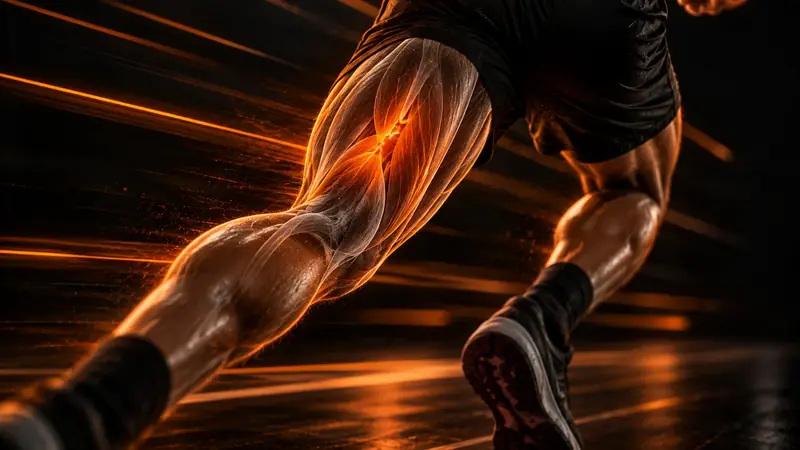
Tuesday, third possession of the scrimmage. A guard pushes the ball up the floor, plants to change direction and grabs the back of his thigh. Ten minutes later the head coach asks the question every staff gets: “Two weeks?”
Nobody can answer that honestly from the calendar. A hamstring strain is not like a bruise that fades on a schedule. The muscle can feel fine walking, fine jogging, and still give out the first time it is asked to do what basketball asks of it. So the useful question is not “how many days”, it is “what has to be true before he goes back”.
What hamstring injuries look like in the NBA
Hamstring strains are not the most common basketball injury. In a 17-year overview of the NBA, lateral ankle sprains (we cover the return-to-play checklist for ankle sprains separately) made up 13.2% of injuries and hamstring strains 3.3% (Drakos et al., 2010). Rare enough to forget, frequent enough that every staff deals with them.
A recent descriptive study looked at 181 NBA hamstring injuries over four seasons (2019 to 2022), using public injury reports and game footage (Luxenburg et al., 2026). Some of what it found:
- Guards accounted for 65.7% of the injuries.
- Players missed an average of 5.5 games.
- Within three months of coming back, 16.0% hurt the same hamstring again and 5.0% hurt the other one.
- In the 45 injuries with usable video, 62.2% had no contact, and the most common moment (41.9%) was the player starting a plant or a jump with the injured leg.
Two cautions. Injury reports are not medical records, so the numbers describe what teams made public, not everything that happened. And the study is descriptive: it tells you what injured players looked like, not what would have prevented it.
The part we find useful is the mechanism. A plant or a jump is not a straight-line sprint. If the standard return test in your gym is “run fast in a straight line”, it leaves out a good share of how these injuries happen on a court.
Why the calendar is a poor judge
One review of the rehabilitation literature put it plainly: nearly one third of hamstring strains recur within the first year after return to sport, and the second injury is often worse than the first. The authors suggest athletes may be going back too early because the return criteria are inadequate (Erickson & Sherry, 2017).
Nor can anyone give a reliable date on day one. A review of 16 studies found no strong evidence that any clinical finding at the start predicts the time to return. There was moderate evidence for three things: pain at the time of injury, the athlete’s own prediction and the clinician’s prediction. Fifteen of the 16 studies had a high risk of bias (Schut et al., 2017).
In one cohort of 80 athletes with MRI-confirmed injuries, two things were independently linked to the time to return: how long the athlete himself expected it to take, and the deficit in passive straight leg raise. For grade 1 and 2 injuries, the MRI findings were not linked to anything (Moen et al., 2014). The authors concluded that prognosis should rest on clinical findings, not on the scan.
None of that gives you a date for the head coach. What it gives you is a reason to stop promising one and to start measuring.
The five checks experts agree on
There are no validated return-to-play criteria for hamstring injuries. That is what the authors of a Delphi consensus study said before they set out to build a list. They asked every professional soccer club in England to take part. Only 20 did (a 21.7% participation rate), but those 20 stayed through three rounds, and they agreed on 12 criteria grouped in five domains: functional performance, strength, flexibility, pain and the player’s confidence. The most highly rated criteria were in functional performance, with particular weight on sprinting (Zambaldi et al., 2017).
So this is an expert agreement in English soccer, not a validated tool and not basketball data. We use it because nothing better exists, and because the five domains hold up when you map them onto what a basketball staff can check.
1. Pain
Not “does it hurt when he runs”, but two narrower questions. Is there any localised tenderness when you press on the injured area? And how does it feel the next morning? In a cohort of 80 athletes followed for a year, localised discomfort on palpation just after return to play went with almost four times the odds of a reinjury (adjusted odds ratio 3.95, 95% CI 1.38 to 11.37) (De Vos et al., 2014). That interval is wide, so read it as a warning sign, not a precise number. It costs thirty seconds and no equipment.
2. Strength
Compare the injured leg with the healthy one, and compare the same way every time. In the same cohort, a larger isometric knee flexion force deficit at 15 degrees after return was also an independent predictor of reinjury (De Vos et al., 2014). A hand-held dynamometer is enough if you have one. We are not giving a percentage here because no study has validated one. Write down what you measure and watch the trend.
3. Flexibility
The same two studies point at range of movement. A passive straight leg raise deficit was linked to a longer time to return (Moen et al., 2014), and a deficit in active knee extension after return was an independent predictor of reinjury (De Vos et al., 2014). Measure both sides, in the same position, with the same person doing the measuring.
4. Sprinting, and what basketball adds
This is where the consensus puts the most weight: can he sprint at full speed without holding back? We would add two steps the soccer consensus does not need. Because the NBA footage shows plants and jumps, the ladder back should include a hard deceleration and a plant-and-go change of direction, and a jump and a landing, before the first scrimmage. That is our reading of the data above, not something a trial has tested.
One thing from a different sport is worth carrying over. In Australian rules football, players whose high-speed running in a given week was far above their own average had much higher odds of a hamstring injury (odds ratio 6.44 for the previous week), while total distance and session RPE showed no useful difference (Duhig et al., 2016). It was one team over two seasons, so treat it as a pattern, not a rule. The practical point is about how you rebuild: do not go from zero sprinting to a full practice in one step. We wrote about the wider picture in load management in basketball.
5. Confidence
The Delphi panel included the player’s confidence as a criterion, and it matches what staffs see: a player who is protecting the leg is not ready, whatever the numbers say. Ask him. Then watch the first hard cut and see whether he trusts it.
Clearance is not the finish line
The NBA study counted 16.0% same-hamstring reinjuries within three months of return (Luxenburg et al., 2026), and the Dutch cohort had 17 reinjuries in 64 athletes (27%) within a year (De Vos et al., 2014). They measured different things in different players, so do not set one against the other. What they share is that a lot of reinjuries happen after the player has been cleared. In the Dutch cohort, the number of previous hamstring injuries was also an independent predictor.
Our suggestion, not a tested protocol: repeat the same checks in the first weeks after clearance, under the same conditions, so you can see a drift before the player feels it.
Does the pain have to be zero during rehab?
Not necessarily. A randomised trial of 43 men with acute hamstring strains compared rehabilitation within pain-free limits with rehabilitation up to a pain threshold. Median time to clearance was 15 days in the pain-free group and 17 in the pain-threshold group, a difference that was not statistically significant. At clearance, isometric knee flexor strength had recovered about 15% more in the pain-threshold group, and the fascicle length of the long head of the biceps femoris had improved 0.91 cm more at two months. Two players in each group were reinjured by six months (Hickey et al., 2020).
It is a small trial, in men, with a standardised protocol run by researchers. It does not say “train through pain”. It says that cautious rehab was not faster and that tolerating some discomfort did not hurt the outcome in that group.
Where the Nordic curl fits
For prevention, the best evidence is for the Nordic hamstring exercise. A meta-analysis of 15 studies found that programmes including it had about half the hamstring injuries of programmes without it (risk ratio 0.49, 95% CI 0.32 to 0.74). When the studies with a high risk of bias were removed, the ratio moved to 0.55 (0.34 to 0.89) (van Dyk et al., 2019). One of the trials behind that result followed 942 Danish male soccer players for a season and counted 15 acute hamstring injuries in the group that did the programme against 52 in the control group (Petersen et al., 2011).
Nearly all of that is soccer and other running sports. We did not find a trial in basketball players that counted hamstring injuries. So the Nordic curl is a reasonable thing to add, with the honest label that the injury data come from other sports. If you add it, build up the volume slowly and keep it in the programme all season, because a one-off block is not what the trials tested. It also has to fit in a real week: see how we fit strength work into an in-season schedule.
The short version
- Time since injury is a guide. It is not a criterion.
- Check pain on palpation, strength, flexibility, sprinting and the player’s confidence, and compare with the other leg.
- In the NBA video sample, the most common moment was a plant or a jump. Add deceleration, change of direction and jumping to the sprint ladder.
- Rebuild high-speed running in steps. Do not jump from none to full practice.
- Reinjuries happen after clearance too. Repeat the checks in the first weeks.
- The criteria above are a consensus, not validated cut-offs. Say so to your head coach.
Hamstring strains in basketball: frequently asked questions
How long does a hamstring strain take to heal in basketball players?
Nobody can give a reliable date on day one. In a descriptive study of 181 NBA hamstring injuries, players missed an average of 5.5 games (Luxenburg et al., 2026), but a systematic review found no strong evidence that any clinical finding at the start predicts the time to return (Schut et al., 2017). Use checks, not a calendar.
When can a basketball player sprint again after a hamstring strain?
When he passes the same checks on both legs: pain on palpation, strength, range of movement, full-speed sprinting and his own confidence. A Delphi consensus in professional soccer agreed on these five domains, with the most weight on sprinting (Zambaldi et al., 2017). There are no validated cut-offs, so say that to your head coach.
How do basketball players injure their hamstrings?
In the NBA video sample, 62.2% of the injuries had no contact and the most common moment (41.9%) was the player starting a plant or a jump with the injured leg (Luxenburg et al., 2026). That is why the return ladder should include deceleration, change of direction and jumping, not only straight-line sprints.
Do hamstring injuries come back?
Often enough to plan for it. The NBA study counted 16.0% same-hamstring reinjuries within three months of return (Luxenburg et al., 2026), and a Dutch cohort had 17 reinjuries in 64 athletes within a year (De Vos et al., 2014). They measured different things, so do not compare the two numbers directly.
Does the Nordic hamstring curl prevent hamstring injuries in basketball?
In a meta-analysis, programmes that included the Nordic hamstring exercise had about half the hamstring injuries of programmes without it (van Dyk et al., 2019). Nearly all of that evidence comes from soccer and other running sports; we did not find a trial in basketball players that counted hamstring injuries.
Does hamstring rehab have to be pain-free?
Not necessarily. In a small randomised trial of 43 men, rehabilitation up to a pain threshold was not slower than pain-free rehabilitation and did not do worse on reinjury at six months (Hickey et al., 2020). It does not say to train through pain, and it should be run by the clinician in charge.
References
- Drakos MC, Domb B, Starkey C, Callahan L, Allen AA. Injury in the National Basketball Association: a 17-year overview. Sports Health. 2010;2(4):284-290. PubMed 23015949
- Luxenburg D, Costello JP 2nd, Treger D, et al. Epidemiology and video analysis of hamstring injuries in the National Basketball Association. J Athl Train. 2026;61(7):490-497. PubMed 42453597
- Erickson LN, Sherry MA. Rehabilitation and return to sport after hamstring strain injury. J Sport Health Sci. 2017;6(3):262-270. PubMed 30356646
- Moen MH, Reurink G, Weir A, Tol JL, Maas M, Goudswaard GJ. Predicting return to play after hamstring injuries. Br J Sports Med. 2014;48(18):1358-1363. PubMed 25037199
- Schut L, Wangensteen A, Maaskant J, Tol JL, Bahr R, Moen M. Can clinical evaluation predict return to sport after acute hamstring injuries? A systematic review. Sports Med. 2017;47(6):1123-1144. PubMed 27757818
- Zambaldi M, Beasley I, Rushton A. Return to play criteria after hamstring muscle injury in professional football: a Delphi consensus study. Br J Sports Med. 2017;51(16):1221-1226. PubMed 28246078
- De Vos RJ, Reurink G, Goudswaard GJ, Moen MH, Weir A, Tol JL. Clinical findings just after return to play predict hamstring re-injury, but baseline MRI findings do not. Br J Sports Med. 2014;48(18):1377-1384. PubMed 25037201
- Duhig S, Shield AJ, Opar D, Gabbett TJ, Ferguson C, Williams M. Effect of high-speed running on hamstring strain injury risk. Br J Sports Med. 2016;50(24):1536-1540. PubMed 27288515
- Hickey JT, Timmins RG, Maniar N, et al. Pain-free versus pain-threshold rehabilitation following acute hamstring strain injury: a randomized controlled trial. J Orthop Sports Phys Ther. 2020;50(2):91-103. PubMed 32005093
- van Dyk N, Behan FP, Whiteley R. Including the Nordic hamstring exercise in injury prevention programmes halves the rate of hamstring injuries: a systematic review and meta-analysis of 8459 athletes. Br J Sports Med. 2019;53(21):1362-1370. PubMed 30808663
- Petersen J, Thorborg K, Nielsen MB, Budtz-Jørgensen E, Hölmich P. Preventive effect of eccentric training on acute hamstring injuries in men's soccer: a cluster-randomized controlled trial. Am J Sports Med. 2011;39(11):2296-2303. PubMed 21825112
PFB Academy is coming
Online courses in English from our expert team. Join the waitlist to hear first.

PFB Performance Team
Strength & conditioning and rehab specialists in professional basketball. Published 20 October 2026 · last reviewed 20 October 2026. Clinically reviewed by Jaime Capellá, physiotherapist and strength & conditioning coach.